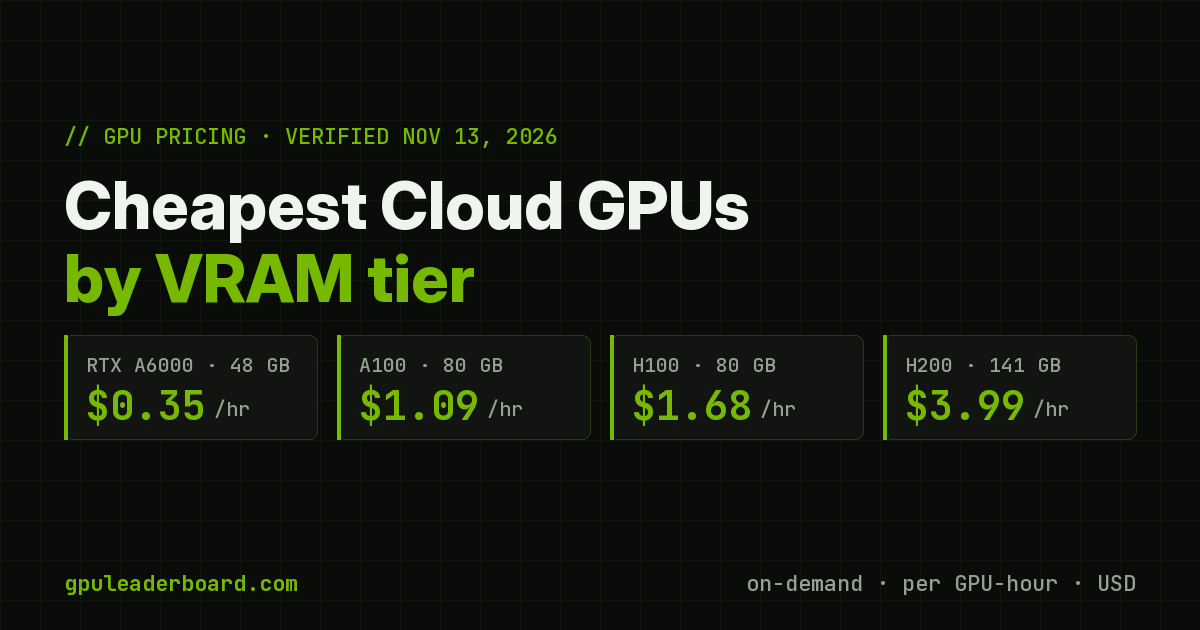
What Is a Token Factory? AI Factory Economics, Explained
A token factory is AI infrastructure judged by one output: tokens. Here is the cost-per-token formula, NVIDIA's Hopper vs Blackwell claim, what tokens cost on GPUs rented at verified Nov 13, 2026 prices, and the 4 products now called "Token Factory."
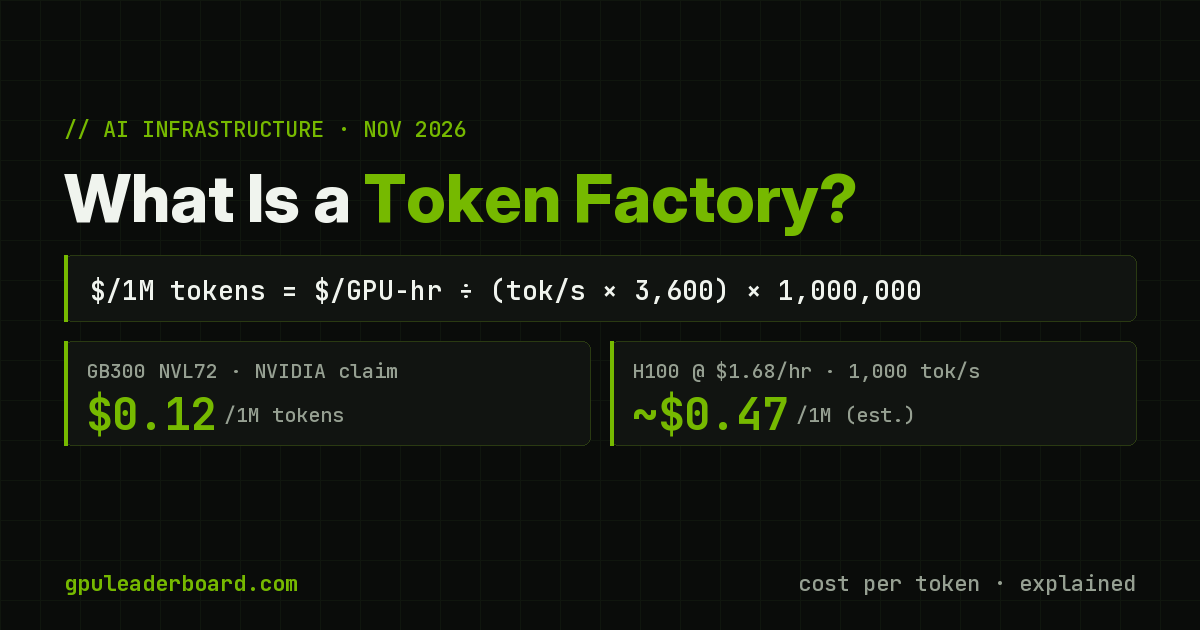
A token factory is AI infrastructure built and judged by one output: tokens. The term comes from NVIDIA's "AI factory" framing, where a data center takes in power and produces tokens for models and agents. Its key numbers are tokens per second, tokens per watt and cost per million tokens. Since October 30, 2026, KT, Rafay and Lenovo have each launched or expanded a product called "Token Factory."
Last verified: November 13, 2026. Vendor performance figures are labeled as vendor claims.
TL;DR
- Definition: a token factory turns GPUs, power and software into tokens, and it is measured by cost per token.
- The formula: cost per 1M tokens = GPU $/hr ÷ (tokens/s × 3,600) × 1,000,000.
- NVIDIA's claim: GB300 NVL72 at $0.12 per 1M tokens vs $4.20 for Hopper (H200), on DeepSeek-R1.
- Our math: an H100 rented at $1.68/hr costs about $0.47 per 1M tokens at 1,000 tokens/s (illustrative speed).
- The products: Nebius, Rafay, KT and Lenovo all sell something called "Token Factory," and they are different things.
What is a token factory?
NVIDIA describes AI factories as infrastructure built to "manufacture intelligence." Energy goes in and tokens come out. In that framing, a data center is judged like a plant. It is judged on output per unit of power and cost per unit produced. NVIDIA's own token cost post says data centers have become AI token factories, and inference is their main workload.
NVIDIA's AI factory explainer names 5 metrics:
- Tokens per second: how fast the system produces output.
- Tokens per watt: output per unit of power. Power is usually the hard limit.
- Cost per token: the all-in cost of each delivered token, usually quoted per 1M tokens.
- Utilization: the share of time the GPUs do useful work.
- Uptime: the share of time the system is available.
How do you calculate cost per million tokens?
NVIDIA publishes this formula:
Cost per 1M tokens = [GPU $/hr ÷ (tokens per GPU per second × 3,600)] × 1,000,000
The top half is what you pay for compute. The bottom half is what that compute produces. A cheaper GPU with much lower throughput can still cost more per token.
NVIDIA's Hopper vs Blackwell example
NVIDIA's April 15, 2026 post gives this comparison on DeepSeek-R1. The source is NVIDIA analysis plus the SemiAnalysis InferenceX v2 benchmark. These are vendor figures, and the post does not list batch size or latency targets.
| Metric | Hopper (HGX H200) | Blackwell (GB300 NVL72) |
|---|---|---|
| Cost per GPU per hour | $1.41 | $2.65 |
| Tokens per second per GPU | 90 | 6,000 |
| Tokens per second per MW | 54K | 2.8M |
| Cost per 1M tokens | $4.20 | $0.12 |
Plugging NVIDIA's own inputs into its formula gives $0.12 for GB300 and about $4.35 for Hopper. The small Hopper gap likely comes from rounded inputs.
Note the $1.41/hr H200 figure. The cheapest H200 rental we verified on November 13, 2026 was $3.99/hr on Hyperstack. Owning hardware and renting it are priced very differently.
What does a token cost on rented GPUs?
Here we apply the same formula to on-demand prices we verified on November 13, 2026. Real throughput depends on the model, precision, batch size, context length and serving engine. So we show 3 illustrative speeds, not benchmark results.
| GPU (cheapest verified rental) | $/hr | At 100 tok/s | At 1,000 tok/s | At 5,000 tok/s |
|---|---|---|---|---|
| H100, Latitude | $1.68 | $4.67 | $0.47 | $0.09 |
| H200, Hyperstack | $3.99 | $11.08 | $1.11 | $0.22 |
| B200, Massed Compute | ~$5.43 | $15.08 | $1.51 | $0.30 |
Values are cost per 1M tokens, assuming 100% utilization. Estimates only.
Utilization matters as much as speed. Effective cost = formula result ÷ utilization. At 60% utilization, the H100's $0.47 becomes about $0.78 per 1M tokens. Check the live rental prices on our cheapest GPU page, and see the full breakdown in Cheapest Cloud GPUs by VRAM Tier. Run your own numbers with the cost calculator.
Which companies sell a "Token Factory"?
The same name now covers 4 different products:
| Product | Type | What it does | Latest news |
|---|---|---|---|
| Nebius Token Factory | Per-token API | OpenAI-compatible inference and fine-tuning for open models. Serverless and dedicated endpoints | Retired some Serverless models on Nov 9, 2026 |
| Rafay Token Factory | Operator software | Lets neoclouds and enterprises publish models as token-metered services | Added Token Router, token budgets and cached-input pricing on Nov 5, 2026 |
| KT Token Factory | Multi-model platform | One API to 73 models at launch, with routing and token-based billing | Launched Oct 30, 2026 in South Korea |
| Lenovo Wanquan Hybrid Token Factory | Infrastructure program | Commercializes token production on Lenovo data center infrastructure | Announced Nov 10, 2026 in Zhangjiakou, China |
Of the 4, Nebius is the self-serve developer API. Rafay sells the software layer to GPU clouds. KT targets businesses first and plans access for individual developers from March 2027. Lenovo's program is focused on China.
How to use token factory math
- Buying API tokens: compare $/1M tokens directly. Check input, output and cached-input prices separately.
- Renting GPUs: measure your own tokens per second on your model and settings. Then apply the formula with the real $/hr and your expected utilization.
- Choosing hardware: a pricier GPU can win if its throughput rises faster than its price. That is the core of NVIDIA's Blackwell argument.
- Planning a cluster: if power is fixed, tokens per megawatt sets your ceiling.
What this article does not cover
- Benchmarks: we did not run throughput tests. The speeds in our table are illustrative.
- Hidden costs: storage, networking, idle time, engineering time and taxes all raise real cost per token.
- Vendor claims: NVIDIA's numbers come from NVIDIA analysis and a single named benchmark. Independent results may differ.
- Product pricing: we did not compare per-token prices across the 4 Token Factory products.
Methodology and disclaimers
- Sources: NVIDIA's token cost post (Apr 15, 2026) and AI factory explainer (May 27, 2026). Rafay's Nov 5, 2026 release, Nebius Token Factory docs, Korea Times on KT, and CEO Insights Asia on Lenovo.
- GPU prices: on-demand list prices verified on each provider's pricing page on November 13, 2026: Latitude, Hyperstack, Massed Compute. B200 is an 8-GPU node price divided by 8.
- Estimates: every cost per token in our own table is a calculation at assumed speeds and 100% utilization, not a measured or quoted price.
- Vendor figures: NVIDIA's table is reported as published and labeled as a vendor claim.
- Accuracy: prices change often, and automated price tracking can be outdated or wrong. Confirm prices and terms with each provider. This is not purchasing advice.
- Accessed: November 13, 2026.
Compare GPU rental prices across 24 clouds on our providers page.
Frequently asked questions
What is a token factory?+
A token factory is AI infrastructure built and measured by its output of tokens. The term comes from NVIDIA's AI factory framing, where a data center turns power into tokens and is judged on tokens per second, tokens per watt and cost per token.
How do you calculate cost per million tokens?+
NVIDIA's formula is: cost per 1M tokens = GPU $/hr ÷ (tokens per GPU per second × 3,600) × 1,000,000. Divide the result by utilization to get the effective cost.
How much does a token cost on a rented H100?+
At the $1.68/hr Latitude price verified on Nov 13, 2026, an H100 producing 1,000 tokens per second costs about $0.47 per 1M tokens at full utilization. That is an estimate. Real throughput depends on the model and settings.
Is Nebius Token Factory the same as an AI token factory?+
No. Nebius Token Factory is a per-token API for open models. "Token factory" is also a general term for AI infrastructure, and Rafay, KT and Lenovo use the same name for different products.
Are NVIDIA's cost-per-token numbers independent benchmarks?+
No. NVIDIA's $0.12 vs $4.20 per 1M tokens comparison comes from NVIDIA analysis and the SemiAnalysis InferenceX v2 benchmark on DeepSeek-R1. Treat it as a vendor claim.