Spot vs On-Demand GPUs: How Much Cheaper, and What You Risk (November 2026)
Spot H100s ran 20% to 50% below on-demand at 5 clouds on Nov 14, 2026, and Nebius preemptible started from $0.79/hr. Here is what each discount costs you in notice, storage and rework.
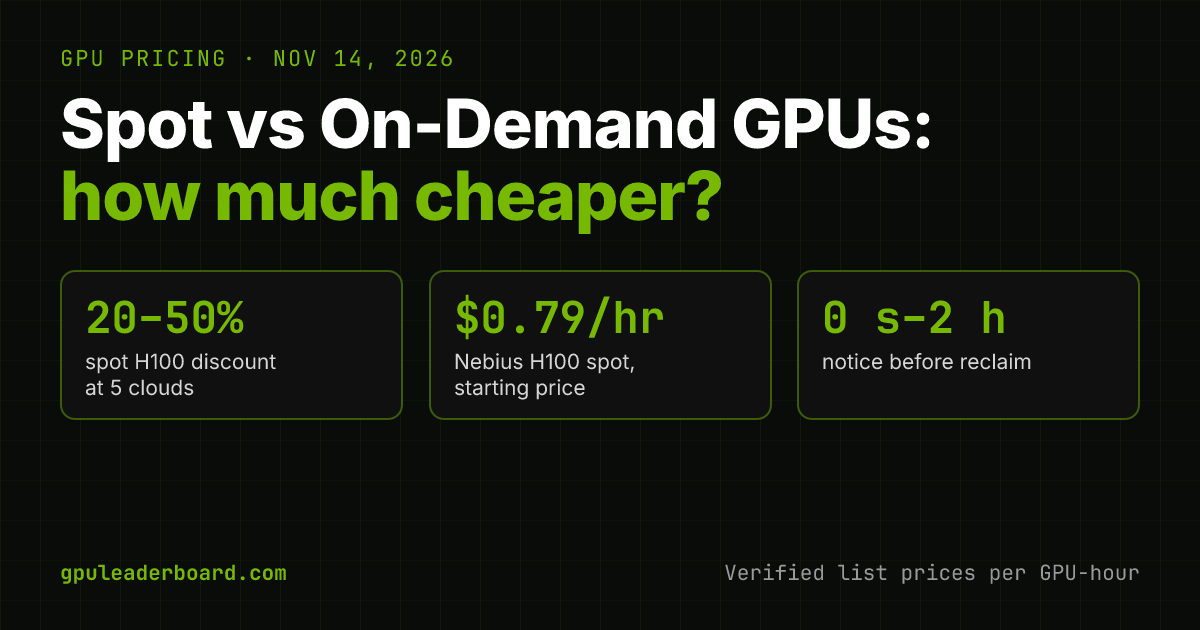
Spot vs on-demand GPU pricing comes down to one trade: you pay less per hour, and the provider can take the GPU back. On November 14, 2026, the spot H100 prices we checked ran 20% to 50% below the same provider's on-demand rate. Nebius's dynamic preemptible H100 started from $0.79/GPU-hr, against $4.50 on-demand. Notice before a reclaim ranged from none to about 2 hours.
Last verified: November 14, 2026. Prices are public, self-serve list prices per GPU-hour in USD, read from each provider's own pricing page.
TL;DR
- Hyperstack prices spot 20% below on-demand, Daytona about 42.5% below, and Verda and Together AI 50% below.
- Nebius preemptible prices are dynamic. They start from $0.79/GPU-hr for H100 and H200, and can change every 15 minutes.
- Hyperstack and Spheron give no fixed notice. Nebius sends a 60-second SIGTERM, and DigitalOcean aims for at least 2 hours.
- The smaller the discount, the less rework you can absorb. A 20% discount stops paying off once restarts add more than 25% to your GPU-hours.
- A dedicated H100 can cost less than some spot H100s. Latitude lists one at $1.68/hr, below every fixed spot H100 price in our table.
What is the difference between spot and on-demand GPUs?
An on-demand (Dedicated) GPU is yours until you stop it. You pay the list rate and the provider does not reclaim it.
A spot, preemptible or interruptible GPU uses spare capacity. The provider can stop it when that capacity is needed elsewhere. Providers use all three names. In this post, every such offer is labeled Interruptible.
How much cheaper are spot GPUs in November 2026?
These are H100 prices from providers that list both tiers on the same page. All prices are per GPU-hour.
| Provider | H100 listing | Type | Price/GPU-hr | On-demand/GPU-hr | Discount | Notice before reclaim |
|---|---|---|---|---|---|---|
| Nebius | HGX H100 | Interruptible (dynamic) | from $0.79 | $4.50 | up to 82% | 60 s SIGTERM |
| Together AI | HGX H100 | Interruptible | $1.99 | $3.99 | 50% | Not stated |
| Hyperstack | H100 PCIe | Interruptible | $2.00 | $2.50 | 20% | None |
| Spheron | H100 (form factor not stated) | Interruptible | $2.20 | $2.98 | 26% | Not stated |
| Daytona | H100 (GPU only) | Interruptible | $2.27 | $3.95 | 42.5% | Not stated |
| Verda | H100 SXM5 | Interruptible | $2.595 | $5.189 | 50% | Not stated; can be seconds |
| Latitude | H100 80GB, 1 GPU | Dedicated | — | $1.68 | — | Not reclaimed |
For Hyperstack, the spot table names "H100 PCIe" and the on-demand table names "NVIDIA H100". We paired those 2 rows.
The discount rule is usually the same across a provider's whole catalog:
| Provider | Discount rule seen on Nov 14, 2026 | Other examples (interruptible vs on-demand) |
|---|---|---|
| Verda | 50% on every GPU listed | B200 $4.707 vs $9.414; GB300 $7.067 vs $14.13 |
| Together AI | about 50% | H200 $2.99 vs $5.99; B300 $5.75 vs $11.49 |
| Daytona | about 42.5% (34.7% on B300) | MI355X $3.44 vs $5.99; B300 $4.08 vs $6.25 |
| Hyperstack | 20% (Hyperstack calls it a "fixed % reduction") | A100 $1.08 vs $1.35; L40 $0.80 vs $1.00 |
| Nebius | dynamic, "from" prices | B200 and B300 from $0.99 vs $8.50 and $9.50 |
| DigitalOcean | spot only for these GPUs; price locked at creation | B300 $6.17; MI355X $4.50; MI350X $3.00 |
Nebius: dynamic "from" prices
Nebius's $0.79 is a starting price, not a fixed rate. Nebius says spot prices can rise or fall with capacity, as often as every 15 minutes. Check the current price in its console before you plan a budget around it.
Hyperstack: small discount, no persistence
Hyperstack spot VMs get no termination notice. They don't support hibernation, snapshots or boot-from-volume, and data on them doesn't persist.
DigitalOcean: the longest stated notice
DigitalOcean lists B300, MI355X and MI350X as Spot GPU Droplets with no on-demand price on the same page. It aims to give at least 2 hours' notice, but says it may give less or none in emergencies.
What does a real job cost on spot?
Take a fine-tuning run on 8 H100s for 24 hours, which is 192 GPU-hours. Restarts cost time, so assume spot needs 15% more GPU-hours. That 15% is an illustration, not a measured rate.
Formula: cost = GPUs × hours × (1 + rework share) × price
| Provider | On-demand cost | Spot cost (+15% rework) | Saving |
|---|---|---|---|
| Together AI | $766.08 | $439.39 | 42.6% |
| Daytona | $758.40 | $501.22 | 33.9% |
| Spheron | $572.16 | $485.76 | 15.1% |
| Hyperstack | $480.00 | $441.60 | 8.0% |
These are estimates, not quotes. The break-even point is simple: spot stops paying off once rework exceeds (on-demand price ÷ spot price) − 1. That works out to about 100% for Verda and Together AI, about 74% for Daytona's H100, about 35% for Spheron's H100 and 25% for Hyperstack.
You can run your own numbers in the GPU cost calculator.
When should you use spot GPUs?
Spot fits work that can stop and resume:
- Training and fine-tuning with checkpoints saved every 15 to 30 minutes to storage that outlives the instance (Spheron's guidance).
- Batch inference, evaluations and data processing that pull from a queue.
- Dev and test boxes you can rebuild in minutes.
Use Dedicated GPUs for production endpoints, single-node jobs that can't checkpoint, and anything with an SLA. Spheron, for example, ties its 99.99% SLA to dedicated instances only.
Before you start, compare absolute prices, not just discounts. Hyperstack's spot H100 at $2.00 costs about the same as Together AI's preemptible H100 at $1.99. Latitude's dedicated H100 at $1.68 costs less than both. Check today's cheapest GPUs and the full leaderboard.
What does the hourly price leave out?
- CPU, RAM and disk: Daytona prices GPUs on their own and bills vCPU, memory and storage as separate lines. Verda lists vCPU and RAM next to each instance and prices storage separately.
- Lost storage: Hyperstack spot VMs keep no data. Verda lets you choose whether attached volumes are kept or released when a spot instance is evicted.
- Networking: Hyperstack charges public IPs at the standard rate on spot VMs.
- Form factor: Spheron's H100 page doesn't say whether the price is for SXM or PCIe. Hyperstack's spot H100 is PCIe.
- Availability: we didn't check live stock. Spot capacity can be unavailable when you try to launch.
- Taxes and minimums: Nebius prices exclude VAT and other taxes. None of the rows above required a multi-GPU node.
Methodology and disclaimers
We read every price on November 14, 2026, from the provider's own page:
- Verda pricing and Verda services overview
- Nebius prices and Nebius preemptible VM docs
- Together AI pricing
- Daytona pricing
- Hyperstack GPU pricing and Hyperstack spot VM docs
- Spheron H100 rental
- DigitalOcean GPU Droplet pricing
- Latitude.sh pricing
- For context: AWS Spot interruption notices (2 minutes) and Google Cloud Spot VMs (best effort, up to 30 seconds)
How we built the tables:
- Conflicts: where our tracker and a provider page disagreed, we used the provider's number.
- Scope: public, self-serve list prices only; reserved and contract prices are excluded. Rows are ranked by verified list price only.
- Units: all prices are per GPU-hour. Verda doesn't label its unit, so we read its "1x" instance as 1 GPU.
- Labels: "Not stated" means the pricing page or docs we read give no notice period.
- Estimates: discounts and job costs are our calculations, not quotes.
- Accuracy: automated tracking can be outdated or wrong. Confirm price, region and stock with the provider before you buy. This is not purchasing advice.
See every tracked provider in the provider directory, or start with the cheapest cloud GPUs by VRAM tier.
Frequently asked questions
How much cheaper are spot GPUs than on-demand in November 2026?+
On November 14, 2026, spot H100 prices were 20% to 50% below the same provider's on-demand rate at 5 fixed-price clouds: Hyperstack 20% ($2.00 vs $2.50), Spheron 26% ($2.20 vs $2.98), Daytona 42.5% ($2.27 vs $3.95), and Together AI and Verda 50%. Nebius preemptible H100 started from $0.79/GPU-hr against $4.50 on-demand, but that price is dynamic.
How much notice do you get before a spot GPU is reclaimed?+
It depends on the provider. As of November 14, 2026, Hyperstack gives no termination notice, Nebius sends a SIGTERM 60 seconds before stopping a preemptible VM, AWS gives 2 minutes, Google Cloud gives up to 30 seconds (best effort), and DigitalOcean aims for at least 2 hours on Spot GPU Droplets. Verda says a spot instance can be removed seconds after creation.
When does a spot GPU stop saving money?+
Spot stops paying off once restarts and lost work add more GPU-hours than the discount covers. The break-even rework share is (on-demand price ÷ spot price) − 1. With November 14, 2026 prices, that is about 100% at Together AI and Verda, about 74% for Daytona's H100, about 35% for Spheron's H100 and 25% at Hyperstack.
What costs does the spot GPU hourly price leave out?+
The hourly price may leave out CPU, RAM and disk (Daytona bills them as separate lines), storage (Verda prices it separately), public IPs (Hyperstack charges them at the standard rate on spot VMs) and taxes (Nebius prices exclude VAT). Hyperstack spot VMs also keep no data, so save checkpoints to storage that survives the instance. Prices checked November 14, 2026.
Is spot always the cheapest way to rent an H100?+
No. On November 14, 2026, Latitude listed a dedicated 1-GPU H100 at $1.68/hr, below every fixed-price spot H100 we checked (Together AI $1.99, Hyperstack $2.00, Spheron $2.20, Daytona $2.27, Verda $2.595). Only Nebius's dynamic preemptible starting price ($0.79) was lower.
More from the blog
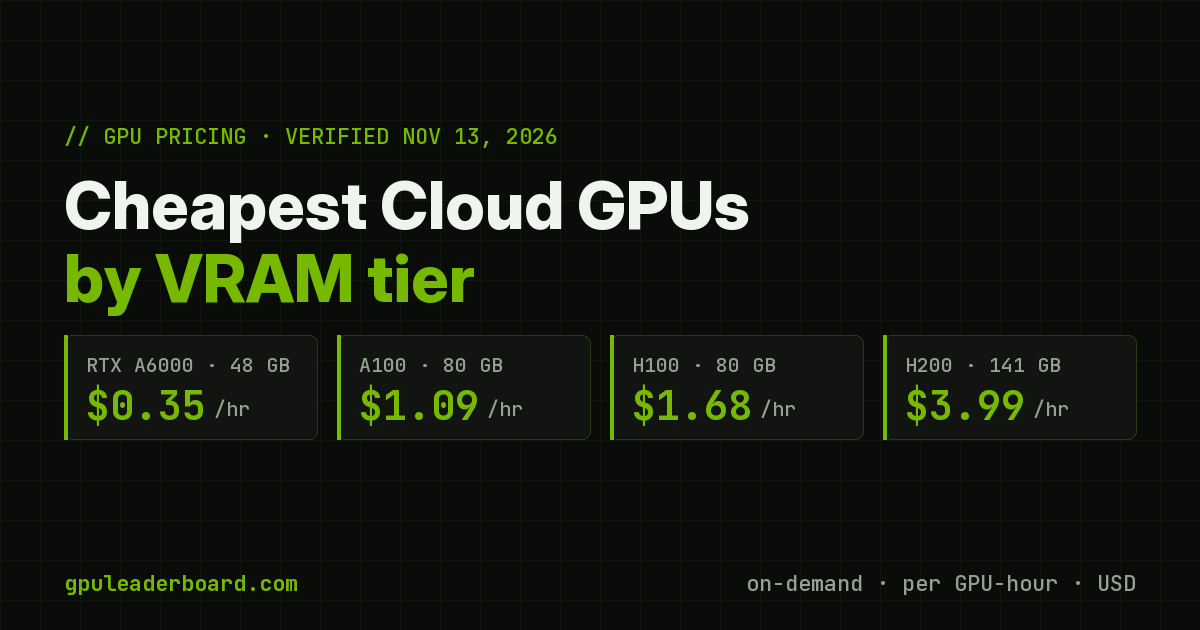
Cheapest Cloud GPUs in November 2026: Verified Prices by VRAM Tier
The cheapest cloud GPU at every VRAM tier on Nov 13, 2026: RTX A6000 at $0.35/hr, A100 80GB at $1.09/hr and H100 at $1.68/hr. Every price is checked on the provider's own pricing page, with interruptible and dedicated options labeled.
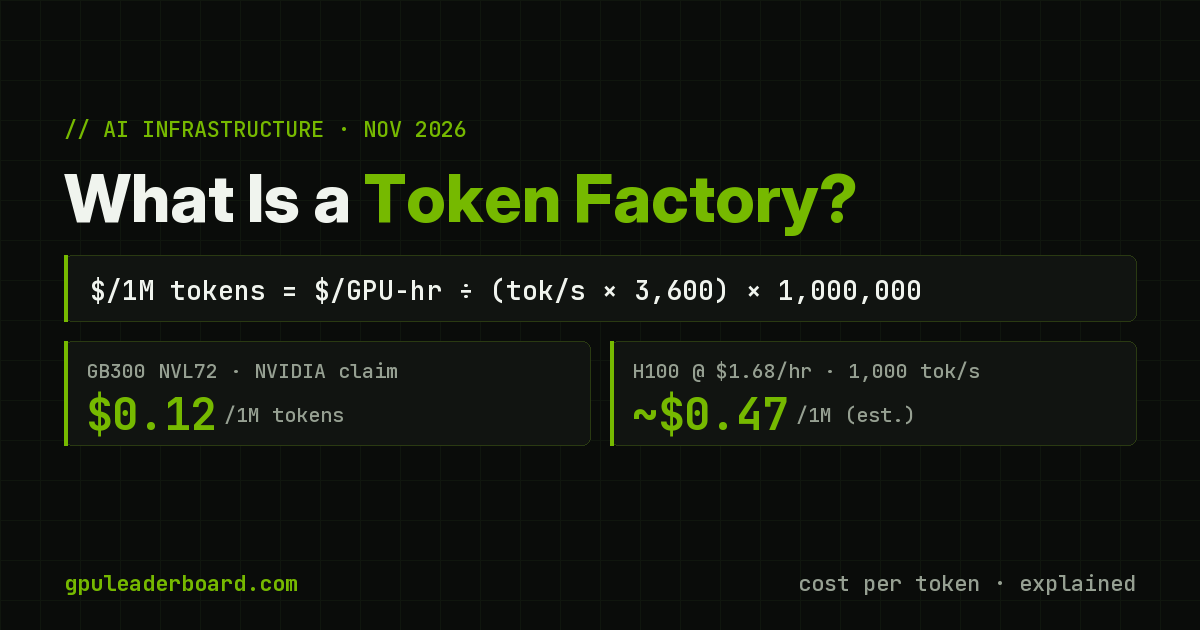
What Is a Token Factory? AI Factory Economics, Explained
A token factory is AI infrastructure judged by one output: tokens. Here is the cost-per-token formula, NVIDIA's Hopper vs Blackwell claim, what tokens cost on GPUs rented at verified Nov 13, 2026 prices, and the 4 products now called "Token Factory."